
DevOps
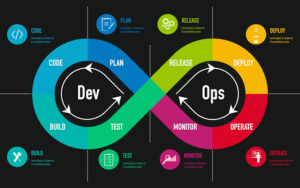
DevOps is a set of practices, cultural philosophies, and tools that aim to unify and automate the processes between software development and IT operations teams. The goal of DevOps is to shorten the development lifecycle, improve deployment frequency, and deliver high-quality software reliably and efficiently. It emphasizes collaboration, continuous integration and delivery (CI/CD), infrastructure as code (IaC), monitoring, and rapid feedback loops. By breaking down silos between development and operations, DevOps enables organizations to respond more quickly to customer needs, reduce errors in deployment, and scale systems effectively.
DevOps is a set of practices, cultural philosophies, and tools that aim to unify and automate the processes between software development and IT operations teams. The goal of DevOps is to shorten the development lifecycle, improve deployment frequency, and deliver high-quality software reliably and efficiently. It emphasizes collaboration, continuous integration and delivery (CI/CD), infrastructure as code (IaC), monitoring, and rapid feedback loops. By breaking down silos between development and operations, DevOps enables organizations to respond more quickly to customer needs, reduce errors in deployment, and scale systems effectively.
- Continuous Integration (CI)
- Automatically building and testing code when developers push changes.
- Detects errors early in the development cycle.
- Tools: Jenkins, GitHub Actions, GitLab CI, CircleCI.
- Continuous Delivery (CD) & Continuous Deployment
- CD (Delivery): Automating the release of code to staging or production.
- Continuous Deployment: Every code change that passes tests is automatically deployed to production.
- Tools: Spinnaker, Argo CD, Octopus Deploy.
- Infrastructure as Code (IaC)
- Managing and provisioning infrastructure using code and automation.
- Ensures consistency and repeatability across environments.
- Tools: Terraform, Ansible, Pulumi, CloudFormation.
- Monitoring & Logging
- Tracking performance, uptime, errors, and logs.
- Enables observability and proactive issue detection.
- Tools: Prometheus, Grafana, ELK Stack (Elasticsearch, Logstash, Kibana), Datadog.
- Version Control
- Central to all DevOps practices.
- Enables collaboration and history tracking.
- Tools: Git, GitHub, GitLab, Bitbucket.
- Automation & Scripting
- Automating repetitive tasks like testing, builds, and deployments.
- Tools: Bash, Python, PowerShell, Makefiles.
- Containerization & Orchestration
- Running applications in isolated, portable environments.
- Automating deployment, scaling, and management.
- Tools: Docker, Kubernetes, Podman, OpenShift.
- Configuration Management
- Managing system configurations and software installations across servers.
- Tools: Ansible, Chef, Puppet, SaltStack.
- Security (DevSecOps)
- Integrating security early into the DevOps lifecycle.
- Practices: static code analysis, dependency scanning, secret management.
- Tools: SonarQube, Snyk, HashiCorp Vault, Trivy.
- Collaboration & Communication
- Aligning dev, ops, QA, and security teams with shared goals.
- Tools: Slack, Microsoft Teams, Confluence, Jira.
What is DevOps?
DevOps is a set of practices that combines software development (Dev) and IT operations (Ops) to shorten the software development lifecycle and deliver features, fixes, and updates frequently in a reliable and automated way.
What are the main goals of DevOps?
Faster delivery, improved collaboration, continuous improvement, higher deployment success rates, and increased operational efficiency.
How is DevOps different from traditional IT?
Traditional IT often separates development and operations. DevOps emphasizes automation, collaboration, and shared responsibility throughout the software lifecycle.
Kerala
Thiruvalla, Pandalam, Adoor, Pathanamthitta, Kayamkulam, Kottayam, Marthandam, Neyyattinkkara, Nedumangad, Thiruvananthapuram City, Kilimanoor, Karikode, Kollam City, Karunagapally, Punalur, Anchal, Kuttikkanam, Elappara, Kalamassery, Kaloor, Angamali, Thrissur, Palakkad, Manjeri, Valanchery, Perinthalmanna, Calicut (Kozhikode), Perumbavoor, Vyttilla, Alappuzha, Harippad.
Tamil Nadu
Velachery, Anna Nagar, Thiruvattiyoor, Neyveli, Aranthangi, Pudukottai, Nagapattinam, Karaikal, Ariyalur, Mulumichampatti, Saravanampatti, Gandhipuram, Kumbakonam, Mayiladuthurai, Vaniyambadi, Vellore, Tirupattur (Vellore), Kancheepuram, Thiruvannamalai, Hosur, Hosur East.
Karnataka
Bangalore Electronic City, Mysore Kuvempunagar, Mysore City.
Andhra Pradesh
Panruti, Dilsukhnagar, Chittoor, West Godavari.
Maharashtra
Panvel, Dombivli, Dombivli East, Thane, Kalyan, Akurdi, Chinchwad, Nigdi, Karvenagar, Revet, Kothrud.
West Bengal
Kolkata, Durgapur.
Rajasthan
Sikar, Kota, Jhalawar.
Jharkhand
Ranchi.
Uttar Pradesh
Allahabad, Lucknow, Rambagh.